
By Homie Farmer, Tech Editor, Smart Agriculture News
The promise of vertical farming has captivated the imagination of technologists, urban planners, and consumers alike. In a world grappling with a rising population, climate volatility, and strained supply chains, the idea of growing fresh, local produce year-round in climate-controlled indoor environments is more than just appealing—it feels essential. Stacking crops in vertically layered systems, independent of weather and geography, offers a tantalizing glimpse into a more resilient food future.
However, transitioning vertical farming from a novel concept into a scalable, economically viable industry is a complex engineering challenge. It requires more than just shelves and lights; it demands the seamless integration of a sophisticated technology stack. To truly “activate” vertical farming and unlock its potential, operators must master a core set of interconnected systems that work in concert to create the perfect environment for plant growth. These technologies are not just tools; they are the foundational pillars upon which the entire enterprise is built. Here are the five critical technologies you need to know.
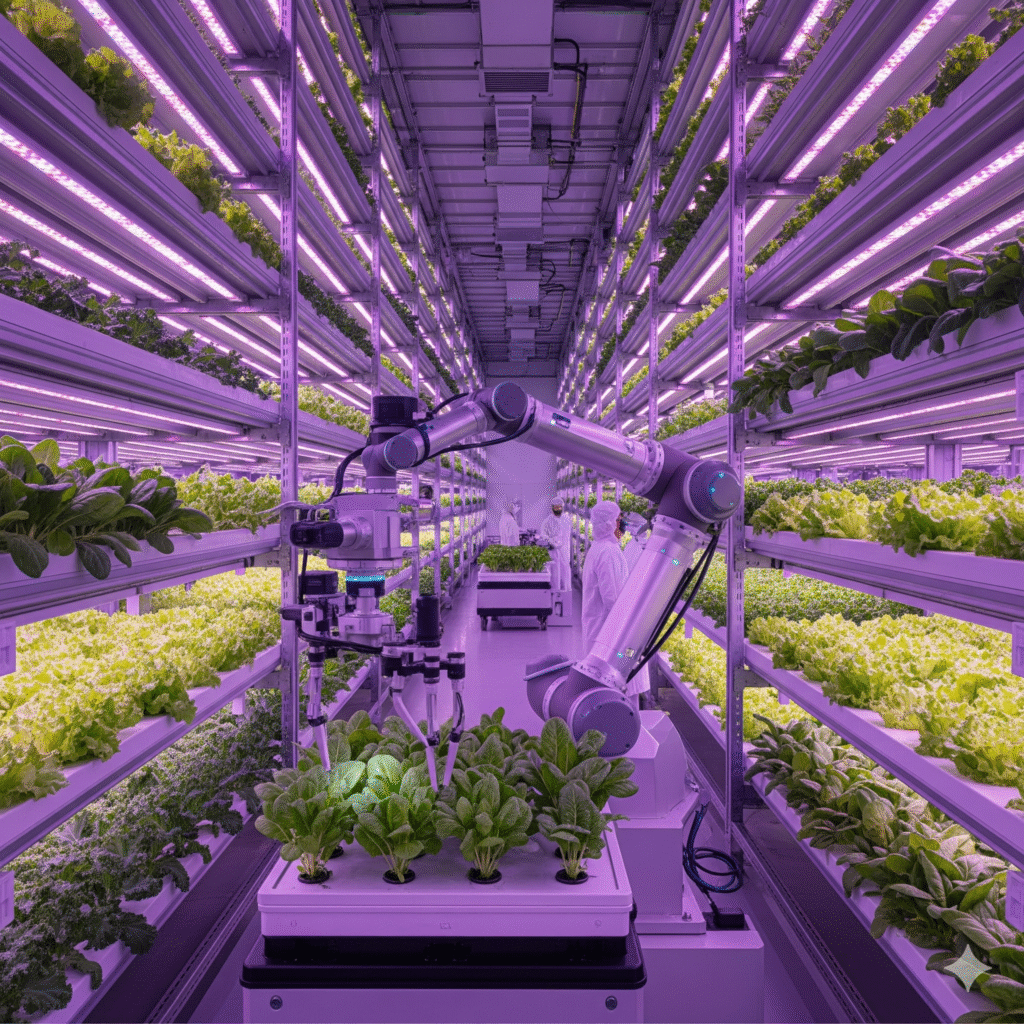
1. Dynamic, Full-Spectrum LED Lighting
For decades, the single greatest barrier to profitable indoor farming was the cost and inefficiency of lighting. The advent of advanced Light-Emitting Diodes (LEDs) has been the game-changer, but the technology required today goes far beyond simple illumination. Modern vertical farms rely on dynamic, full-spectrum LED systems that function as a form of photobiology, giving growers unprecedented control over plant development.
This technology is not just about providing light; it’s about providing the right light at the right time. Full-spectrum LEDs can be programmed to create specific “light recipes” tailored to different crops and even different growth stages. For example, a grower can increase the blue light spectrum to promote robust vegetative growth in leafy greens, then shift to a higher concentration of red light to encourage flowering and fruiting in crops like strawberries. The intensity can be ramped up and down to mimic the natural progression of a day, from a gentle sunrise to a bright midday sun and a soft dusk, reducing stress on the plants.
The “why” is twofold: optimization and efficiency. By delivering the precise wavelengths of light that plants need for photosynthesis, these systems maximize growth rates, can enhance nutritional profiles (e.g., increasing antioxidants), and even improve the flavor and texture of the final product. Just as critically, modern LEDs are incredibly energy-efficient compared to their predecessors. Since lighting is one of the largest operational expenditures in a vertical farm, the ability to deliver optimized light recipes while minimizing electricity consumption is fundamental to achieving profitability. Without this level of control and efficiency, the economic model of a vertical farm simply cannot work at scale.
2. Precision Climate and Environmental Control
The core value proposition of vertical farming is its independence from the external environment. This is achieved through precision climate and environmental control systems, which are responsible for creating the perfect growing conditions 24 hours a day, 365 days a year. This goes well beyond a standard thermostat; it is a holistic system that meticulously manages every atmospheric variable within the facility.
These integrated systems are often referred to as HVAC-D (Heating, Ventilation, Air Conditioning, and Dehumidification). Temperature is kept within the optimal range for a specific crop, but just as importantly, humidity is tightly controlled. High humidity can lead to fungal diseases like botrytis or powdery mildew, while low humidity can stress the plants. Advanced dehumidification systems are essential for removing the vast amounts of water vapor that plants transpire.
Furthermore, these systems manage CO2 enrichment. Carbon dioxide is a primary ingredient for photosynthesis, and elevating its concentration inside a sealed facility (often to 800-1200 ppm, compared to the ~400 ppm in the outside atmosphere) can significantly boost growth rates. Sensors constantly monitor CO2 levels, and automated injectors release it as needed. Finally, sophisticated air circulation patterns are designed to ensure there are no microclimates within the farm. Uniform airflow prevents pockets of stagnant, humid air and ensures every plant, whether at the top or bottom of a rack, experiences the exact same conditions. The goal is to create a perfectly homogenous, repeatable environment that eliminates variables and produces a predictable, consistent, and high-quality harvest every single time.
3. Advanced Hydroponic and Aeroponic Systems
Vertical farms are, by nature, soilless. Instead of soil, they rely on highly efficient systems to deliver water and nutrients directly to the plants’ roots. While there are several methods, the most advanced and widely used are hydroponic and aeroponic systems.
Hydroponics involves growing plants in a nutrient-rich water solution. The most common techniques in vertical farming are the Nutrient Film Technique (NFT), where a thin stream of nutrient solution flows over the bare roots, and Deep Water Culture (DWC), where roots are suspended in an aerated vat of the solution. These systems are typically “closed-loop,” meaning the water is captured, replenished with nutrients, and recirculated. This results in staggering water efficiency, often using 90-95% less water than traditional field agriculture. It also gives the grower absolute control over nutrition, allowing them to provide the perfect balance of macro and micronutrients, and eliminates the risk of soil-borne pathogens.
Aeroponics takes this a step further. Instead of submerging roots in water, an aeroponic system suspends the roots in the air and periodically mists them with a fine, nutrient-rich fog. This method provides maximum oxygenation to the root zone, which can lead to even faster growth rates than hydroponics. While more technically complex to manage, high-pressure aeroponics represents the cutting edge of soilless cultivation. Both hydroponics and aeroponics are fundamental to vertical farming because they enable the dense stacking of plants in a clean, controlled, and highly resource-efficient manner.
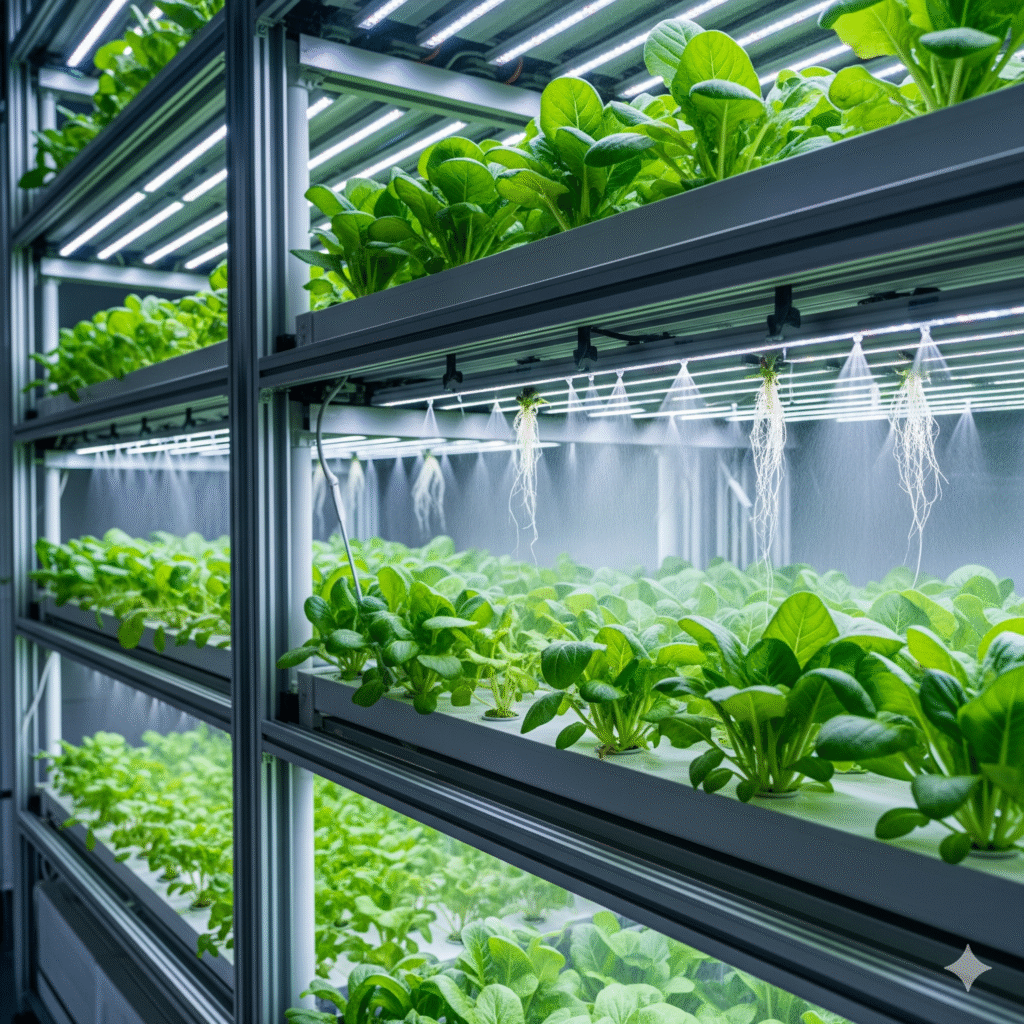
4. Automation and Robotics for Labor Efficiency
One of the most significant operational costs and logistical challenges in a large-scale vertical farm is labor. The repetitive tasks of seeding, transplanting, moving, harvesting, and packaging thousands of plants in a multi-level facility are immense. This is where automation and robotics become not a luxury, but a necessity for scaling profitably.
Automation can be seen at every stage of the production line. Automated seeders can precisely place individual seeds into growing media at high speed. Robotic transplanters use machine vision to identify healthy seedlings and move them into larger trays or growing channels. In the most advanced farms, entire racks are moved by autonomous guided vehicles (AGVs) or conveyor systems, transporting the crops from the germination area to the main grow-out zones and finally to the harvesting station without human intervention.
Robotic harvesting is one of the most complex but impactful areas of automation. Using a combination of cameras and intelligent grippers, these robots can identify mature plants, make a precise cut, and place them onto a conveyor for packaging. This not only dramatically reduces labor costs but also increases throughput, ensures consistency, and enhances food safety by minimizing human contact with the produce. From seeding to sale, automation is the key to making the vertical farm a high-efficiency food factory.
5. AI-Powered Farm Management and Data Analytics
If the technologies above are the body of the vertical farm, then AI-powered farm management software and data analytics are its central nervous system and brain. This is the technology that integrates all the other systems, learns from them, and optimizes their performance. The modern vertical farm is, at its core, a data-generation machine.
An extensive network of Internet of Things (IoT) sensors is deployed throughout the facility. These sensors collect millions of data points in real-time on every conceivable variable: light spectrum and intensity, temperature, humidity, CO2 levels, the pH and electrical conductivity (EC) of the nutrient solution, water flow rates, and more. Cameras with machine vision monitor plant health, identifying discoloration or wilting that could signal stress or disease.
All of this data streams into a central farm management platform. Here, Artificial Intelligence (AI) and Machine Learning (ML) algorithms analyze the information to find patterns that would be invisible to a human operator. The AI can correlate subtle changes in the light spectrum with a 5% increase in yield, or detect a slight change in a pump’s vibration to predict a potential failure weeks in advance (predictive maintenance).
Most importantly, the AI works to perfect the “growth recipes.” By constantly analyzing inputs (light, climate, nutrients) and outputs (yield, taste, nutritional content), the system learns and refines the optimal conditions for each crop, creating a cycle of continuous improvement. This data-driven approach is what elevates vertical farming from simple indoor growing to a true form of precision-controlled agriculture.
The Future is an Integrated Ecosystem
To activate vertical farming is to recognize that these five technologies are not independent components but parts of a single, deeply interconnected ecosystem. The AI is useless without the data from the climate sensors. The advanced lighting is only effective if the nutrient system is providing what the plant needs to take advantage of it. The robotics are only efficient if the entire workflow is managed intelligently.
The journey to a truly sustainable and profitable vertical farming industry is a high-tech one. It is a fusion of biology, engineering, and data science. The pioneers who succeed will be those who not only implement these five technologies but master the art of making them work in perfect harmony, creating a resilient and highly optimized food production system for the cities of tomorrow.
![[정책 안내] 재배 작물이 바뀌면 ‘데이터’도 업데이트하세요!](https://smartnongup.kr/wp-content/uploads/2025/09/20250704_balloonflower.jpg "[정책 안내] 재배 작물이 바뀌면 ‘데이터’도 업데이트하세요!")

![[호미농부의 시선] “멈출 것인가, 갈 것인가” AI 트랙터, ‘예민함’보다 중요한 건 ‘판단력’입니다](https://smartnongup.kr/wp-content/uploads/2025/12/autonomous-AI-trators-John-Deeres.png "[호미농부의 시선] “멈출 것인가, 갈 것인가” AI 트랙터, ‘예민함’보다 중요한 건 ‘판단력’입니다")
![[농기평] 인공지능이 농사 고수라고요?](https://smartnongup.kr/wp-content/uploads/2026/02/IPET-top-title-410x260.png "[농기평] 인공지능이 농사 고수라고요?")
![[카드뉴스] 농업전망 2026 세부 프로그램 및 무료 등록 안내](https://smartnongup.kr/wp-content/uploads/2026/01/card0.png "[카드뉴스] 농업전망 2026 세부 프로그램 및 무료 등록 안내")